
Public transit agencies face several key challenges, including fluctuating service demand, high operating costs, slow technology adoption, and a lack of readiness when responding to unexpected events. Managing these issues requires a shift toward flexible service models, alongside the deployment of smart digital infrastructure, and integration of multimodal mobility options such as bikes and rideshares. Modern cloud-based platforms help transport authorities reduce fixed infrastructure costs while adapting instantly to shifting rider demands through real-time data scaling, seamless payment integrations, and proactive service adjustments. These systems are designed to be highly configurable, making it easy for agencies to introduce new features, adjust pricing, or update schedules.
In this article, we’ll go over the benefits of adopting flexible transit platforms and why agencies need solutions that allow maximum agility and cost control. We’ll discuss how these systems integrate with legacy technology, possibilities for customization, and why transport authorities around the world are partnering with Modeshift to modernize their digital infrastructure.
Benefits Of Flexible Cloud-Based Transit Systems In A Dynamic World
SaaS-based transit systems allow transport agencies to remain flexible by using cloud software and open Application Programming Interfaces (APIs) to add, remove, or update specific operational modules, such as fare collection or route planning, on demand, without replacing entire legacy infrastructure or buying expensive new hardware. Authorities use Open APIs to connect best-in-class tools from different vendors rather than relying on a single, rigid, custom-built system. Subscriptions replace major hardware investments, allowing agencies to turn new features on or off as operating budgets change. Providers manage software updates in the background, minimizing downtime and giving staff instant access to new capabilities. Agencies can scale software features and fleet support up or down based on seasonal changes or shifting public needs. Cloud platforms make it simple to add flexible micro-mobility or on-demand response services alongside fixed timetables. New planning or ticketing features go live in months rather than waiting for slow, multi-year hardware installations. Since vendors handle maintenance and security patches remotely, the system improves continuously without disruptive local overhauls.
SaaS-based transit systems also shift fare collection from rigid, on-premise hardware to cloud-native platforms. By combining Account-Based Ticketing (ABT) and open payments, agencies can update fare rules, launch new payment tokens such as contactless cards or mobile apps, and adjust pricing centrally without modifying physical validators across fleets. Fares and rules are calculated in a secure cloud back-office rather than on a physical card or terminal, allowing instant policy adjustments. Riders use everyday contactless bank cards or mobile wallets (Apple Pay, Google Pay) as travel tokens, removing pre-purchase barriers. Best-fare and daily or weekly capping logic run automatically in the backend, ensuring riders always get the best price. Validators serve as secure identifiers, meaning hardware doesn’t need reprogramming or replacement when policies shift. Agencies can easily link new operators, regional partners, or bike-shares into a single digital account structure, eliminating the need for separate fare media for each distinct operator.
Configurability That Eliminates Surprise Charges From Legacy Systems
Configurability in cloud-based transit systems eliminates surprise charges for public transport agencies by replacing rigid legacy frameworks with modular tools, transparent usage scaling, and centralized policy controls. Agencies can configure and activate specific software modules (such as fare capping or multi-agency routing) on demand via a SaaS platform rather than paying high fees for custom development or expensive change orders. Clear compute and transaction tiers in cloud software help avoid runaway Infrastructure as a Service (IaaS) bills by treating capacity expansions as explicit, budgeted choices. Standardized APIs prevent the proprietary vendor lock-in common with legacy hardware, helping agencies avoid unexpected costs or forced upgrades. By centralizing performance metrics in a single dashboard, agencies gain a unified view of their systems and operations, enabling optimized fleet usage and reduced maintenance overhead.
Open APIs support connections with external apps, open payment systems, and automated scheduling tools by integrating with standard data feeds such as GTFS and GOFS. Fare policies, transfer rules, and zone structures are modified centrally in the cloud back-office rather than manually updating individual physical validators on buses or at stations. This saves valuable time and resources, which can be redirected to more demanding areas. Live dashboards track processing volumes and transaction fees in real time, preventing end-of-month billing shocks from unmonitored data or payment gateway spikes. By consolidating data from various sources such as CAD/AVL and Automated Fare Collection (AFC) systems, authorities can easily modify routes, adapt schedules, and issue passenger alerts in real time during events such as emergencies or detours. Real-time visualization of transactional data also makes it easier to spot financial discrepancies, enabling agencies to take proactive measures before they can negatively impact revenue.
Agility In Meeting New Transit Needs Or Regulatory Changes

Modern cloud-based platforms in public transit deliver enhanced operational agility through automatic cloud updates, instant system scalability, and flexible low-code configurations. These remote-based systems remove the burden of local server maintenance by shifting software upkeep, security patches, and infrastructure upgrades to specialized Software-as-a-Service (SaaS) vendors. Dynamic software tools enable transport authorities to instantly process massive streams of live transit data from thousands of vehicle sensors and passenger taps during peak commuting hours or major public events. This allows agencies to adapt to shifting commuter demands by rerouting buses or launching microtransit shuttles where they are needed most. Cloud environments can easily adjust processing and resource allocation on-demand to handle peak traffic, route expansions, or new partner integrations. This supports the introduction of new zones or routes without expensive server upgrades. Planners can reconfigure parameters and test new on-demand paths without slow, custom software cycles.
Using a subscription SaaS model for public transit converts heavy capital expenditure into flexible operating expenses by allowing agencies to pay for capacity used, while supporting remote management. Transit personnel can update onboard vehicle hardware and monitor system security from any computer without requiring physical on-site intervention. Systems scale vehicle capacity or dispatchers up and down based on real-time traffic and passenger volume. Real-time analytics tools process live mobility patterns to optimize daily transit schedules. Vendors handle security patches, feature enhancements, and backend maintenance seamlessly via the internet without local installations. Critical adjustments deploy instantly in the cloud, removing the manual upgrade delays of old on-premise servers. Agencies can stay up to date with new regional mandates and compliance laws while benefiting directly from the latest platform features. Low-code tools further enable transit personnel to change reporting rules and user permissions as laws shift.
Examples Of How Quick Adaptation Has Helped Other Agencies
Quick adaptation through cloud platforms has helped public transport agencies achieve rapid scalability, handle sudden data surges during emergencies, and launch real-time passenger tools without heavy on-premise hardware investments. In the UK, Transport for London (TfL) manages traffic and surge loads by utilizing a cloud computing solution to scale its digital infrastructure. During unexpected weather events or transit strikes, visitor loads surged up to 20 times normal levels within a single hour, which the elastic cloud handled smoothly without website crashes. TFL further applies cloud-connected machine learning models on the London Underground to analyze subterranean sensor data, predicting motor and door failures on the Central and Victoria lines before they cause delays. In addition, the agency powers over 600 third-party travel apps via APIs for real-time tube, bus, and cycle data, generating up to £130 million in annual economic benefits. The UK Department for Transport (DfT) runs the Bus Open Data Service (BODS), which standardizes and openly publishes local bus timetables nationwide, along with fares and live-tracking data.

In the U.S., agencies also leverage cloud-based systems for real-time tracking, dynamic adjustments, and fleet optimization. The New York City Department of Transportation (NYC DOT) has successfully deployed an Intelligent Transportation System (ITS) in the cloud for real-time monitoring, signal timing adjustments, and rerouting municipal transit assets around congestion or incidents. The Los Angeles County Metropolitan Transportation Authority (Metro) utilizes cloud platforms to monitor vehicle spacing, address bunching or gaps in real time, and feed granular analytics into daily scheduling. In California, the Santa Clara Valley Transportation Authority (VTA) implements dynamic transit data tools to adjust operations and speed up specific core bus routes by up to 20%. Boston’s Massachusetts Bay Transportation Authority (MBTA) leverages cloud-based big data feeds to optimize schedule adherence, track active vehicle locations, and instantly push detour or delay adjustments to operations teams. In Philadelphia, the Southeastern Pennsylvania Transportation Authority (SEPTA) integrates cloud-based analytics to evaluate mixed-fleet positioning and streamline adjustments in the event of unexpected transit disruptions.
How Modeshift’s Platform Handles Peak-load Events
Modeshift’s platform handles peak-load events using an elastic cloud architecture that instantly scales computing resources, storage, and bandwidth in response to real-time ridership demand. This allows agencies to automatically scale system capabilities up or down to handle high-volume surges during major festivals or seasonal shifts. Concurrent user requests and device synchronizations are managed smoothly without straining local hardware, while remote infrastructure reduces reliance on vulnerable, expensive local servers. Fast contactless validation processes high-throughput digital ticketing, mobile apps, and EMV bank card taps instantly at entry points, speeding up boarding during heavy commuter rushes. An account-based core keeps transactions stable at high volumes while ensuring riders benefit from instant, dynamic features such as fare capping. The system feeds real-time data from Computer-Aided Dispatch and Automatic Vehicle Location (CAD/AVL) systems back to control centers, allowing transport authorities to track vehicle capacities and congestion as crowds surge. Sensor feeds, which connect cameras and road sensors, give operators valuable data for future service improvements, enabling instant resource allocation to meet fluctuating demand.
Core Configurable Platform Features
Hardware Agnostic: Modeshift’s platform offers high configurability through modular, hardware-agnostic 360-degree architecture. Agencies customize ticketing rules, reuse legacy equipment, select preferred third-party devices, and deploy tailored Intelligent Transport Systems in as little as 90 days.
Account-Based Ticketing (ABT): Supports both open-loop (cEMV contactless credit/debit cards, mobile wallets) and closed-loop smart cards/tokens in a single framework.
Real-Time Passenger Information (RTPI): Delivers live vehicle tracking, schedules, and arrival estimates to riders via digital signs and applications.
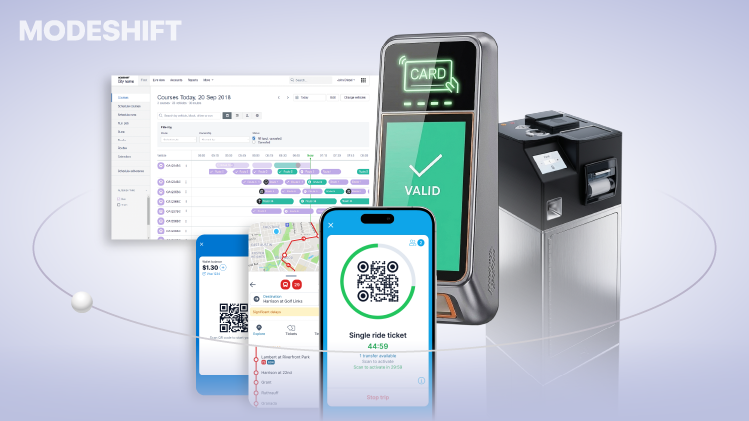
Computer-Aided Dispatch and Automatic Vehicle Location (CAD/AVL): Provides transit agencies with real-time fleet tracking, route management, and operational oversight tools.
Flexible Fare Management & E-Wallet: Allows custom fare policies, capping rules, concessions, and cross-service integration (such as fixed-route and shared-ride/paratransit alignment).
Hardware Integration Suite: Connects seamlessly with onboard fareboxes, validation terminals, ticket vending machines (TVMs), and mobile handheld validators.
In Conclusion
Transit agencies need highly configurable technology to adapt to changing rider needs, integrate with diverse third-party systems, and avoid costly custom coding. This will help scale services smoothly as their local transit networks grow and municipal policies shift over time. It’s important to choose technology that fits an agency’s operational needs and budget rather than chasing expensive high-tech trends. Simple or right-sized tools reduce wasteful spending and ensure systems actually improve daily rider experiences and bus or train reliability. Transit agencies can pick the right technology by focusing on core operational problems, auditing existing data infrastructure, and prioritizing modular, scalable tools. This also involves testing solutions with small pilot programs and measuring return on investment before making large purchases. Authorities can start by identifying specific service gaps, slow routes, or passenger complaints before looking at products, and decide if software or hardware can be upgraded or integrated instead of replaced. They also need to factor in long-term maintenance, software updates, staff training, and vendor lock-in risks.
Investing in flexible tools that share data easily with other software will help avoid costly custom fixes, while a modular-first approach can help stay within budget. Agencies can save money by purchasing singular features rather than massive, all-in-one software suites. When choosing a technology provider, authorities should check whether the vendor’s software supports open data standards such as GTFS, GTFS-RT, or SIRI, and if the technology integrates directly with current dispatch, CAD/AVL, or ticketing systems. Open data standards will help ensure transport authorities can power live trip planners and maps while delivering real-time vehicle arrival updates to passengers. Removing common vendor lock-in issues ensures agencies can easily swap software later on without losing data. By integrating ticketing data into Computer-Aided Dispatch and Automatic Vehicle Location (CAD/AVL) systems, transit agencies can access real-time passenger load counts, which improves schedule reliability and helps operators respond faster to disruptions, while providing rich data for future route planning and service adjustments.


