Generative AI offers a powerful blend of policy and technology that holds the potential to revolutionize transportation by optimizing routes, improving vehicle and infrastructure design, enhancing safety, and streamlining operations. Distinct from traditional forecasting and analytical tools, GenAI models possess the remarkable ability to create, innovate, and envision multiple scenarios and outcomes that were previously not possible. These technological advancements have enabled transport authorities to dynamically generate new solutions, policies, strategies, and insights that optimize various aspects of transport planning and management.
In this article, we’ll review some of the key applications of Generative AI in transportation and how cities can leverage this innovative technology to enhance transportation systems and urban living.
Understanding Generative AI And Its Role In Transportation
Generative AI (GenAI) refers to a cutting-edge subset of Artificial Intelligence that specializes in creating innovative content and solutions. Unlike traditional AI systems that depend on pre-programmed rules and datasets, generative AI is capable of autonomously producing new, contextually relevant content. Conventional forecasting technologies tend to focus on analyzing existing data within separate, isolated systems. In contrast, generative AI explores new ideas and possibilities, visualizing potential outcomes in real-time while providing details on how, when, and where they will occur. This kind of transparency enhances access to information, opportunities, and collaboration at unprecedented levels.
The technology’s ability to translate complex policy documents, design plans, and data into understandable, visually engaging formats is truly groundbreaking. GenAI’s capacity to communicate information or a particular outcome through real-time images and videos will enable professionals from different fields to come together and redefine how entire cities and transport systems are designed, managed, and upgraded. In the context of public transportation, Generative AI could help authorities come up with innovative solutions to a variety of complex mobility challenges. By deploying advanced algorithms and feeding them the right data, cities can plan, predict, and anticipate multiple outcomes, while creating a comprehensive, realistic view of future projects before they become reality.
Generative AI Enables Dynamic Traffic Management

Generative AI excels in traffic management by analyzing vast amounts of data, simulating traffic scenarios, and optimizing traffic flow. This leads to reduced congestion in cities, improved safety for all road users, and more efficient resource allocation. By looking at real-time data from sensors, cameras, and GPS, generative AI can dynamically adjust traffic signal timings, suggest optimal routes for vehicles, and even reroute traffic to avoid heavily congested areas. The result is smoother traffic flow, reduced emissions, and improved air quality. The technology can also simulate various traffic scenarios and interventions (e.g., rerouting, signal timing adjustments) to assess their impact before implementation, helping refine strategies and optimize traffic management plans.
Intelligent Transport Systems are being used in many parts of the world, and they’re evolving. Singapore has successfully reduced delays through the use of AI-powered road management systems. This involves machine learning models that predict traffic surges, adjust road signals, and reroute vehicles based on real-time data. China implemented a revolutionary AI traffic management system called ‘’City Brain’’ which reduced traffic congestion by as much as 40%. Transport for London (TfL) has also implemented an AI system for adaptive traffic signal adjustments, which responds to real-time data and alleviates congestion in the city. In Pittsburgh, an AI system called ‘’Sirra’’ resulted in a 25% reduction in travel times and a 40% decrease in vehicle idling. Lisbon partnered with a technology company to deploy AI-driven traffic management solutions at 260 intersections, leading to significant improvements in travel times.
Enhancing Demand Forecasting and Resource Allocation Through Generative AI
Generative AI enhances demand forecasting in transportation by processing large datasets and predicting passenger flows with greater accuracy. This allows for optimized scheduling, improved resource allocation, and a better overall passenger experience. GenAI models can analyze historical data, weather patterns, event schedules, and other factors to predict passenger demand on specific routes. This means transport companies can optimize vehicle deployment, ensuring sufficient capacity on popular routes. By looking at traffic patterns and predicting congestion, generative AI can suggest the most optimal routes for public transport vehicles, minimizing delays, overcrowding, and improving overall travel times.

Since AI models rely on sensor data from vehicles and infrastructure, they can identify potential issues before they occur, enabling proactive maintenance of fleets and ensuring vehicles are always readily available when needed. Generative AI is also capable of optimizing the allocation of resources like maintenance staff and spare parts, further reducing costs for agencies and improving efficiency. What’s even more interesting is that GenAI models can recognize subtle patterns and anomalies in data that might indicate shifts in consumer preferences or potential disruptions, enabling agencies to anticipate and respond to changes. Transport for London (TfL) uses AI to predict passenger demand and optimize bus and train schedules. The result is a 10% increase in on-time performance and a reduction of passenger wait times by 15%.
Delivering Improved Passenger Experiences With Generative AI
Generative AI can significantly enhance the passenger experience in public transit by offering personalized information, optimizing routes, and providing real-time updates. Generative AI analyzes passenger data, including travel history and preferences, to offer tailored recommendations for routes, modes of transport, and even fare estimates. AI-powered systems can provide up-to-the-minute information on arrival times, platform changes, and potential disruptions through mobile apps and other channels. For instance, a system could alert a wheelchair user about step-free access options or inform a visually impaired passenger about accessible routes. Chatbots powered by generative AI offer instant support to passengers through voice or text, answering queries about schedules, routes, or ticketing.
Interactive voice response (IVR) systems enable passengers to communicate with the system using natural language, making it easier to access information and assistance. Generative AI is also enhancing passenger safety in public transit by enabling real-time monitoring and improved security measures. AI-based surveillance systems monitor activities within transit vehicles and at stations, alerting security personnel to potential incidents. By analyzing data in real-time, AI can help security personnel respond more quickly and effectively to incidents, potentially preventing escalation. The technology’s ability to process large volumes of data during emergencies makes it possible to deliver accurate and timely information to passengers and emergency responders.
Leveraging The Power Of Generative AI For Predictive Maintenance

Generative AI models, including Generative Adversarial Networks (GANs) and Machine Learning (ML), can analyze historical and real-time data to identify patterns and predict potential failures in both vehicles and infrastructure. Unlike other models, GenAI is capable of creating synthetic data to augment existing datasets, especially when real-world failure data is limited. This allows for more robust and accurate predictive models. By looking at sensor data from vehicles and infrastructure, transport authorities can predict potential maintenance issues, allowing for proactive repairs and reduced downtime. For instance, real-time data from brake systems helps detect early warning signs of potential failures, such as abnormal temperatures, vibrations, or fluid leaks. The technology’s ability to simulate various failure scenarios is also very useful for maintenance teams, who can train to anticipate problems and prepare for them.
Generative AI models are highly effective in optimizing maintenance schedules and can even simulate different maintenance scenarios to find the most effective strategies. This includes creating tailored maintenance schedules for each vehicle based on its specific usage and condition, rather than relying on a one-size-fits-all approach. By optimizing maintenance schedules and preventing unexpected breakdowns, generative AI can reduce maintenance costs over time while improving service reliability. Singapore’s advanced predictive maintenance system is truly one of a kind, having been integrated into more than 62% of the country’s bus fleets. The system, which deploys AI and machine learning, enables technicians to anticipate and correct failures before they can result in bus breakdowns. The result was a 20% decrease in bus breakdowns.
How Generative AI Helps Facilitate Data-Driven Decision Making
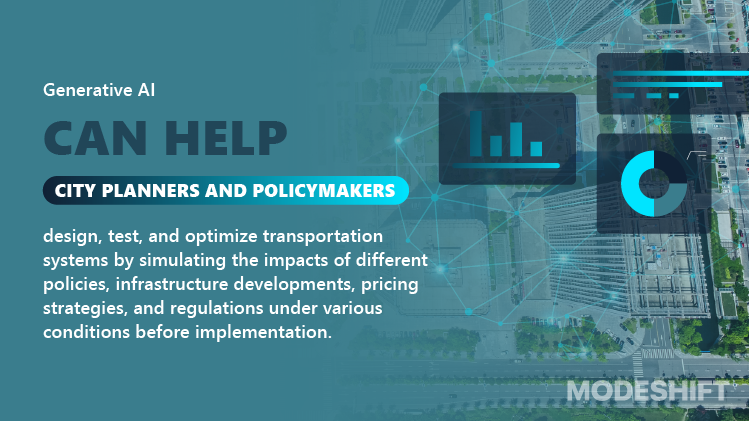
Generative AI can be used to simulate the impact of different transport policies and strategies, helping city planners make informed decisions about infrastructure development, pricing, and regulations. By simulating the potential outcomes of different policy interventions, policymakers can assess their effectiveness before implementation. The technology can assist in designing and optimizing transportation infrastructure, such as roads, bridges, and public transit systems. By combining data analysis and scenario generation, generative AI could simulate the behavior of an entire transportation system under different conditions, allowing for testing and optimization.
For instance, by deploying techniques such as GANs (Generative Adversarial Networks) and VAEs (Variational Autoencoders), generative AI could create realistic scenarios of traffic flow, weather conditions, and even disruptions to simulate how the system might react. These insights could save cities a lot of time and resources, enabling them to strategically enhance the overall performance and efficiency of transit networks. GenAI could also be applied for multi-modal modelling to show the interactions between different modes of transportation, such as buses, trains, cars, and bicycles, allowing cities to understand how they interact with each other. This could be a game-changer in developing future frameworks for MaaS ecosystems, helping ensure their success.
In Conclusion
While Generative AI may be unlocking new possibilities for the transportation sector, it’s important to remember that Artificial Intelligence is meant to enhance human expertise, not replace it. The technology’s benefits can be truly utilized when used intentionally, meaning we have to diligently structure it, feed it the right data, and know how to interpret the results. To fully leverage the capabilities of GenAI, cities need to adopt a comprehensive strategy that emphasizes AI-compatible infrastructure, along with strategic partnerships and effective governance. Upskilling employees in GenAI is also vital to ensure they can optimize workflows and make strategic decisions.
Investment in standardized and interoperable data systems is equally important, along with utilizing real-time IoT and GPS information. Cities will need to collaborate with various industry and government stakeholders and initiate pilot projects. It will be critical to establish strong governance structures to guarantee ethical AI implementation, while safeguarding data privacy and maintaining transparency. Developing the workforce through training and hiring is further vital to ensuring these systems are evolving correctly and are achieving the desired results. By leveraging the strengths of GenAI, we can create transportation systems that are smarter, responsive, more efficient, and highly adaptable to the needs of communities.