
Greenhouse gas emissions from transportation are growing faster than any other sector, with conventionally fueled vehicles serving as a major source of urban air pollution. The transportation sector is currently responsible for around one-quarter of all greenhouse gas emissions. 91% percent of the energy used in motorized transport on land, sea, and air is notably derived from fossil fuels making this sector among the hardest to decarbonize. The urgency to meet climate targets is further reinforced by the growing mobility needs of populations who demand affordable, convenient, and frictionless journeys. Making people want to shift from their cars to other transport modes requires an increase in the adoption of low-carbon mobility options such as shared mobility, investment in public transport, and the upgrading of walking and cycling infrastructure. Breaking up the current predominating car-centric system implies that authorities will need to provide urban dwellers with viable travel alternatives that are greener and capable of supplementing their daily travel requirements. MaaS promises to deliver the flexibility and convenience riders want, as well as becoming a suitable alternative to car ownership by helping citizens shift to more sustainable transport models and reinforcing behavioral change. In this article, we’ll look at Mobility as a Service (MaaS) and its role in helping cities achieve their sustainable transport goals. We’ll also go over current obstacles regarding the implementation of such projects and how we can overcome them to utilize the full potential of MaaS platforms.
Mobility As A Service: An Evolving Ecosystem That Promises To Make Multimodal Travel A Reality
In the United States, government authorities are taking bold action toward tackling the effects of climate change. In 2021, the nation rejoined the Paris Agreement with an ambitious pledge to reduce net greenhouse gas emissions by 50-52%. A fundamental step in this is to take off endotherm vehicular traffic from roads as well as accelerate investments in greener vehicles and support new business models that promote the use of clean and shared vehicles. Data from the International Institute for Sustainable Development shows that transportation currently accounts for roughly 64% of global oil consumption, in combination with 23% of the world’s energy-related carbon dioxide emissions. Given the urgency for climate action, the public has also declared their desire and preference for more environmentally friendly modes of transportation. A recent report by the Natural Resources Defense Council concluded that citizens want more sustainable transportation choices and they are prepared to make the necessary changes that accommodate greener, more environmentally friendly alternatives for their daily travels. To address these challenges as well as demands from populations, cities have been trying to ban the use of cars in city centers and instead promote greener forms of transport. These include the introduction of more dedicated bike lanes as well as shared electric and micro-mobility initiatives to make cities more accessible for residents, commuters, and tourists. Greener, multimodal transportation is helping cities advance their efforts to counter climate change while also giving the public accessible transportation options that better cater to their evolving needs.

Mobility as a Service (MaaS) is often looked at as the universal solution to promoting multimodality due to its capabilities to integrate multiple forms of transport and transport-related services into a single, comprehensive, and on-demand mobility service. MaaS provides end-users with the added value of obtaining mobility via a unified application and a sole payment channel, as opposed to multiple ticketing and payment operations. To accommodate customers’ requests, a MaaS operator creates an assorted menu of transport options consisting of mass transit, active modes such as walking and cycling numerous ride-sharing programs. The purpose of MaaS is to provide the best value proposition for users, and societies, with added benefits for the environment. MaaS presents a viable alternative to private cars that may be as convenient, more sustainable and to help to reduce congestion and constraints in transport capacity at an affordable and competitive price. An ecosystem of well-established MaaS services is also thought to be able to increase the accessibility of public transport networks by filling in gaps and connecting all forms of shared mobility. This will encourage a greater proportion of the population to reduce their use of private cars for at least some journeys, especially shorter ones where MaaS services could give a user an advantage in cost or journey time. Current data on journeys made through services available in a MaaS app show that multimodal trips produced 31,4 tons of CO2, on an annual basis. For the same distance of 13km traveled, trips made exclusively by a car using petrol produced 62 tons of CO2 while a vehicle running on diesel produced around 59 tons of CO2, annually.
Cities such as New York, Paris, and London have already made numerous investments in infrastructure that support the shift toward multimodal transportation. For instance, London, Milan, and Seattle have developed extensive bike lanes during the time of the Covid-19 pandemic which are now permanent, leading to an increase in bike usage. This move signifies how a proactive approach to urban planning can produce a positive impact, allowing cities to adapt their infrastructure and effectively accommodate changing transportation habits. It also suggests a not-so-distant future where cities are more citizen-orientated, prioritizing active and shared mobility modes and promoting healthier lifestyles for the population while reducing carbon emissions. The rise of multimodal transportation is also influencing how urban planners approach traffic management. Cities are now leveraging Artificial Intelligence (AI) simulators to accommodate these changes by allocating road lanes, redistributing traffic light waiting times, and rerouting non-pedestrian transport. If an increase in bike usage is detected, AI can adjust traffic light timings to ensure a smooth flow for cyclists. This development could result in more efficient and safer roads for all users alike, reducing congestion and potentially decreasing accident rates.
MaaS Could Help Us Meet Climate Targets But It Requires A Comprehensive Approach
Despite the environmental impacts of transportation, rising congestion, declining air quality, and spiralling fuel costs, cars remain the most preferred mode of travel among the majority of urban dwellers. This is mainly because cars are often seen as the more convenient option that provides more comfort and freedom for users when compared to other modes of transport. Overturning this preference and reducing the number of cars on the road has long been a priority for cities, public transit authorities, NGOs, and private businesses. It’s generally agreed upon that any greener, multimodal transport service has to be able to get people from point A to point B quickly and efficiently while providing a frictionless experience. In many cases worldwide, public transportation may cover only a portion of riders’ travel requirements, with other alternative modes often needed such as walking, taxi, or bike sharing to help urban dwellers reach their final destination. These gaps force users to pre-plan journeys extensively, with the continuous risk of delays and disruptions. This is the gap that Mobility as a Service (MaaS) must fill if we expect it to become a preferred method of travel among citizens. MaaS platforms need to be designed in such a way that they enable fast, cohesive travel experiences for every planned journey by leveraging open data on transit and roads. To ensure success, MaaS offerings must provide aggregated access to a range of transport modes on demand, and do it from a single digital interface, while covering the maximum amount of ground. This will allow users to plan and pay for journeys as bundles combining options such as rail, bus, scooter, bike, taxi, car rental, and rideshare.

A MaaS solution can only be as good as its foundation, meaning that it requires a robust public transport network to integrate with, along with active travel modes and transport-related services. If we want MaaS to deliver significant results in terms of sustainability, these platforms need to get to a point where the majority of people who can afford to own and operate a car, would be willing to choose a MaaS offering as opposed to driving. For users to relinquish car ownership altogether, they have to be able to trust that MaaS will always provide a reliable and convenient service that is competitive with a private car. This includes integrating services that accommodate members of society who are reliant on ride-railing and car rental services for off-peak or emergency journeys where cars typically prove to be the most convenient modal choice on demand. Data shows us that MaaS propositions could make a significant impact among young people who are not interested in owning a car or driving. The majority of them prefer services that are flexible, time-efficient, and cost-effective. In the USA, around 25% of 16-year-old Americans were reported to own a driving license in 2020 in comparison to 40% in 1997 which depicts a dramatic decrease. However, despite the high hopes of urban planners and mobility advocates, decades of auto-centric development have forced most US residents to drive, even if they don’t want to. If we hope to reduce society’s reliance on automobiles, we need to focus on increasing density and investing in transit and bike lanes — this will let people have real choices about how they travel. Generational shifts might offer some momentum, but without major policy reforms, today’s car-reluctant teens could become tomorrow’s daily drivers.
A Strong Governing Body Is Needed If We Want MaaS To Succeed
The value of developing MaaS lies in its capabilities to deliver substantial sustainability results by improving the efficiency of local transport networks as well as enhancing the quality of rider experience, encouraging more people to choose greener, more low-carbon mobility modes. MaaS is considered a fundamental component that is driving the shift toward multimodal transportation, serving as a catalyst for the digital transformation of transit by combining services and connecting different modes into one unified platform. Additionally, MaaS has initiated new standards for open data systems that aim to improve the stability and effectiveness of larger transport networks. MaaS also faces numerous challenges, particularly when it comes to governance and the development of a universal model and how that would be integrated in different regions and countries. There is currently no single, unified MaaS model that can be applied to all countries, and the operational models vary depending on the region and place. How we create and manage an appropriate business model for MaaS will be the key to developing a successful ecosystem capable of delivering the sustainable outcomes we seek. Furthermore, coordination among different stakeholders in MaaS ecosystems needs to be considered carefully before these projects can be deployed on a larger and more global scale. Data sharing and standardization are thought to be central to facilitating successful MaaS networks. Local governments and other appropriate leaders such as public transport officials are needed to lead the way in reaching a consensus on sharing standards, and in establishing regulations, policies, and mechanisms that aim to improve data sharing. Reinforcing proper monitoring and governance regarding the implementation of MaaS is crucial in ensuring these projects have a positive impact on cities and communities along with being profitable.
When creating a MaaS network, authorities are faced with a variety of difficulties including obstacles regarding the implementation of MaaS. They have to ensure that their efforts are coordinated with the city’s sustainable development strategy and overall goals by conducting continuous evaluations and giving priority to low-carbon and inclusive mobility solutions. Furthermore, MaaS networks need to be positioned in such a way that they can be easily integrated with networks such as public transport which will act as the backbone of future MaaS ecosystems. The success of such systems will also be underlined by their ability to adapt to changing conditions and developments within the sector as these solutions are still in their early stages of global deployment and it’s likely there will be many adjustments happening before they can effectively cater to the needs of populations. Additionally, electric mobility solutions alone are insufficient in delivering the long-term, sustainability results we want and in our transition to greener and more environmentally-friendly transportation. Cities need to be diligent in setting an effective strategy that emphasizes collaboration among participants in MaaS networks while considering regional impacts, compactness, proximity, mixed-use, social integration, and integration with local transport networks. Failure to do so could result in these new solutions not achieving their set targets or not reaching their full potential. Governments are often seen as the ones to bear the responsibility for providing the right environment for the development of MaaS by formulating technical standards, regulations, and policies that enable a healthy and inclusive MaaS ecosystem. For instance, authorities might have to set policies in place referring to fare rates and negotiate them among ecosystem participants. Governments need to revise the subsidy mechanism in order to ensure that MaaS systems include green mobility options, cover low-income groups, and provide adequate services in areas with less accessibility to public transport.
Can New Technology Help Us Overcome The Major Challenges Of MaaS?
Setting up a multimodal transportation network is a very complex and multifaceted process that involves ongoing collaboration among various participants and entities, planning, strategizing, executing, and funds needed to bring it all together. This often comes with a wide array of unforeseen challenges as is the case with many global MaaS pilots. We’ve seen a number of cities all confronted with the problem. Improperly parked e-scooters and rental bicycles flood the streets of busy neighborhoods, creating conflicts and frustrations with other road users and even recklessly endangering people through improper use. Part of the appeal of e-scooter sharing systems is that they are seen as a greener alternative to cars and other rented services by being free-floating and dockless. They are presumed to be good for the environment, they get you to where you need to go faster and can be parked and left virtually anywhere the rider chooses. The reality, however, is that without docking stations, e-scooters often sit cluttering sidewalks and even blocking wheelchair ramps, making it hard to pass without tripping over them. Not surprisingly, many cities have raised their concerns regarding the safety and efficacy of such solutions, with some even reconsidering whether or not they should continue investing in such initiatives. The accumulated growth of e-scooters and vandalism-related incidents have even made some municipalities question if this is a viable solution to making urban travel more sustainable.

Professionals in the field have come to believe that going forward, multimodal transportation planning needs to be reinforced through data-driven solutions and innovations in technology when it comes to everything from constructing bike lanes to managing infrastructure, as well as any digital and physical assets such as e-scooters/payment systems. A viable solution has been proposed through advanced technologies such as digital twins. We’ve seen this high-tech innovation rise in popularity recently, mainly due to its outstanding capabilities in providing a virtual replica of a product, service, or even an urban process. Although many consider digital twins to be a 3D model of a city or region, a true urban digital twin extracts data from several existing technologies for the purpose of visualization and analysis. This can allow cities to leverage these insights, aiding in the development of robust, future-proof multimodal transport strategies. For instance, digital twins can visualize and analyze data pulled from the Internet of Things (IoT) regarding micro-mobility providers, allowing city officials to better identify and understand important mobility patterns and effectively improve policies. Insights derived from digital twins can also be beneficial in large-scale transportation planning by helping transit authorities in meeting emerging multimodal needs. By combining asset and spatial data into a recurrent operational image, stakeholders could plan more efficiently as well as determine the best routes for the deployment of bike and scooter lanes. The availability of real-time data will help with automatically detecting vehicles that are wrongly parked, notifying the mobility service provider precisely where they can pick up the vehicle. Even more interestingly, digital twin technologies can remotely check the battery levels of all vehicles in a fleet to determine whether they need to be picked up for recharging.
Advancements In Payment Technology Could Be The Key To Moving MaaS Forward
The ideal MaaS solution has to be inclusive and accessible, providing services to all members of society regardless of their socioeconomic status, age, disability, or circumstances. MaaS platforms need to be affordable, frictionless, easy to access, and navigate, offering the most information-rich experience for almost every conceivable journey. For this to become a viable reality, the end-user experience of paying for multimodal journeys must be nearly effortless. For instance, let’s imagine a multimodal journey between two nearby cities that demands the use of a bus, a train, and a hailed cab ride. If passengers must obtain individual tickets for the bus and the train, before then having to reach for their wallets again to pay for the taxi, it becomes inconvenient and the number one reason why they might prefer the convenience of their own vehicle. Yet behind every frictionless payment experience is a complicated set of agreements between different stakeholders. The sheer number of parties involved in multimodal travel makes negotiating this ecosystem challenging and is among the main obstacles to a truly scalable MaaS solution. We can think of MaaS as the glue that will join together separate modes of transport, combining them into a single offering. Account-based solutions for MaaS platforms are considered a cornerstone for enabling broader payment acceptance, reinforced by a robust back-office that will support the management of user payments and service-related queries. A huge challenge in creating a unified payment experience for riders lies in the multiple variations between transport modes’ pre-existing payment architectures. Local bus networks might have a very different way of facilitating payments than private rideshare companies or micromobility service providers.
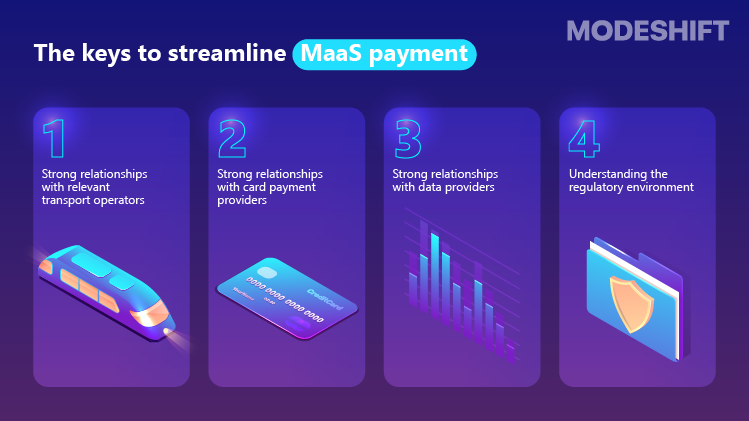
A MaaS platform must mediate between all of them to make sure they receive the appropriate funding they are owed for any provision of services. This requires seamless validation for each journey along with automatically diverting fares to the right providers. The legal and contractual frameworks require an additional layer of complication for participants in these ecosystems as they attempt to take a MaaS product to market. The rise of digital wallets and mobile payments has made it possible for users to pay for their multimodal journeys in new ways that are more convenient for them. However, with the increasing complexity of payment networks in MaaS and multiple channels available for transactions, it can be difficult to optimize payment routing and ensure timely reconciliation. Artificial Intelligence is set to play a critical role in streamlining payments in MaaS platforms by leveraging historical and real-time data to make intelligent decisions about the most suitable payment routes. By examining factors such as cost, speed, reliability, and transaction volume, AI algorithms can decide on the most optimal path for each payment, reducing processing time and additional costs. Furthermore, AI can automate and match incoming payments with the right invoices or purchase orders, eliminating manual intervention and streamlining the entire payment workflow. An AI-powered payment platform may also contribute to enhancing the customer experience by suggesting the most suitable payment method based on a customer’s previous transaction history or offering personalized discounts or promotions.
Unlocking MaaS’s Full Potential As A Rival To Car Ownership Lies In Standardisation
Offering riders a wealth of travel modes available through a single app will also require a substantial amount of data sharing between multiple stakeholders. For this to happen agreed-upon standards need to be set that guarantee data compatibility. In the context of payments, this shared data model could incorporate rules for the type of payment credentials that can be stored and exchanged between MaaS participants. It’s these standards that will enable the creation of custom APIs that convert existing data into a seamless, frictionless payment experience for users. Many have argued that for MaaS schemes to be rolled out and scaled up from a global perspective, its core data model should be centrally and freely available to all. With the abundance of mobility products being launched on the market, the MaaS sector seems to be lagging in producing a high-standard ‘all-in-one’ app that offers seamless payment experiences to end users. Some have proposed that a reference architecture model could serve as a template for functional payment information exchange between the ecosystem’s stakeholders. This reference model should ideally incorporate the types of data to be exchanged, including the standards for sharing them, the APIs facilitating these shares, the established protocol for settling disputes, and the digital infrastructure on which this will occur. If we want MaaS to become a truly sustainable transport model capable of replacing cars and supplementing the mobility needs of citizens we have to create a model where users can seamlessly pay for their rides as well as navigate the ecosystem with ease and assurance. This means aligning private and public partners in a joint effort to overcome the hurdles in the field of payment and ticketing.
There is currently no consensus regarding the appropriate way to take payments for all users of MaaS platforms, particularly the unbanked and those who do not own a smartphone, let alone how disputes and chargebacks will be handled in the future. This means that a patchwork of MaaS services exists worldwide, each offering a set of different features and user experiences. Until a unified standard is established consisting of predetermined protocols for suitable payment models, MaaS will struggle to present a definitive identity to its consumers. This also brings up the question of how integration with legacy technologies will be handled and who will set regulatory standards and will be responsible for managing them. Participants in the MaaS ecosystem such as entrepreneurs may often see themselves as key players in the business mobility landscape, rather than the payments space. Lacking either the domain expertise or the will to define the right mechanisms, MaaS stakeholders may seek contributions from their counterparts in the payments world. Building ecosystems of interoperability that allow competitors to cooperate is the secret ingredient to building successful international payment schemes such as Visa or Mastercard. These incredibly vast systems rely on stress-tested reference architectures and unified data models, with well-established protocols for resolving any disputed charges, in real-time. According to a Visa report, connecting multiple transit services through a single travel and payment method could encourage people to travel more. Nearly half (45%) of the surveyed people stated that they would be more likely to try different forms of public transit if they could use the same payment method for all their trips. An additional 42% said they would increase their usage of public transport.
In Conclusion
The question is no longer if MaaS can help us achieve climate targets but if we are ready to initiate these changes by being proactive and consistent in our efforts to make MaaS a reality. Instead of being spectators, cities should act to steer the development of MaaS in the right direction. If applied in the right way, MaaS platforms offer an outstanding opportunity for improved and more sustainable urban mobility, with public transport as the backbone. This will help curb the effects of climate change as well as allow us to reclaim urban spaces and rebuild streetscapes that are cleaner, safer, and more citizen-orientated. Integrated MaaS platforms can deliver great results in overcoming user challenges associated with unfamiliarity by providing end-to-end journey planning via a single, easy-to-use platform. As an operational model, MaaS possesses the capabilities to enable a viable and desirable alternative to private travel, however, it’s important to remember that citizens need to be encouraged and assisted in the transition to MaaS and the ongoing digital transformation. A MaaS solution has the potential to be a strong ally in the future, but it will only be possible if public governance and MaaS stakeholders can find a common path in favor of populations who are called upon to not only change their habits but also embrace and adopt these new services. Moving forward, we need to increase our adoption of electric and solar-powered vehicles, along with our use of cleaner, renewable fuels and investments in green public transportation systems. These combined efforts can truly help steer society towards a cleaner and more sustainable path for both the planet and its inhabitants.


