The public transportation sector faces significant challenges that demand innovative solutions. Social behaviour, consumer trends and technological advancements require the sector to adapt quickly and efficiently. The question is how to drive change in an agile and effective way. We address this question in an interview with Matthias Augustyniak who led a market-leading enterprise, crafting intricate systems and services for public transport, and revolutionizing urban mobility for over two decades. Now, as the CEO & Co-Founder of OneStop City Services, Matthias is pioneering a new, simple, and agile approach to implementing smart city solutions.
It’s a pleasure to talk to you Matthias. As a start, could you please explain the reasons why you decided to set up your own company after so many years in the public transportation business?
The decision to establish OneStop City Services stemmed from the challenges faced by cities and public entities in the digital age. The challenges are connected with the growing demand for innovation and technological development, social behaviour and consumer trends, as well as political expectations. City officials are under immense pressure to deliver digital solutions in a fast and agile way. However, the journey to digital transformation is fraught with obstacles. This is where OneStop City Services comes into play. What OneStop City Services does is address the challenges the public transportation sector faces while introducing and modernizing digital services with our products and services, as well as an innovative approach to the deployment of digital solutions.
Judging from your experience, what are the biggest challenges that the public transportation sector has to face today?
There are several significant challenges when it comes to introducing and implementing digital solutions in the public transportation sector. These challenges can be broadly categorized into money, time, and risk. We could say that these three categories undermine the ability of the sector to swiftly adapt to the technological development, social behavior and consumer trends mentioned before.
Money. As far as money is concerned, digitalization in the public transportation sector often requires substantial financial investment. These projects are typically very expensive and complex, involving not only the deployment of new technologies but also the integration with existing systems. Funding constraints can make it difficult for public transportation agencies to allocate the necessary resources for comprehensive digital transformation. This financial burden can lead to delays in project initiation and completion, limiting their ability to keep up with technological advancements.
Time. The process of digitalizing public transportation is incredibly time-consuming. Conducting tenders, securing contracts, and implementing solutions can take anywhere from five to eight years. This lengthy time frame is a significant barrier because the rapid pace of technological change means that solutions can become outdated by the time they are deployed. Moreover, lengthy bureaucratic procedures and regulatory compliance add to the overall time required, slowing down the pace of innovation.
Risk. This in turn generates risk. By the time a solution is implemented, it may already be obsolete or inflexible. Additionally, the complexity of these projects often leads to implementation challenges, further increasing the risk of failure. There is also the risk of political and public scrutiny, as stakeholders expect efficient and effective use of public funds.
What do you think are the key factors for initiating positive change in the way innovation is introduced in the sector?
It’s typically best when implemented solutions require no or very simple interfaces to legacy systems. This non-invasive approach reduces the complexity and disruption often associated with integrating new technologies, making them easier and faster for public transportation agencies to adopt. What is also very important is scalability. Clients should have a chance to start with a small deployment and scale up as needed. This means clients could begin with small pilot projects to test the waters before committing to a larger rollout, reducing risk and ensuring a smoother transition.
When a small pilot project is deemed feasible and there is no or very simple interface to the legacy system, the deployment becomes faster, allowing the clients to see benefits almost immediately, without the lengthy downtime associated with traditional system overhauls. This rapid deployment becomes more possible when there’s no initial investment needed. One of the biggest barriers to innovation is the upfront cost of financing the system, deployment, and service. The solution here is a subscription-based model. This means all the client needs to pay is a subscription and/or transaction fee, making it financially feasible for even the most budget-constrained public entities to implement cutting-edge technologies. This flexibility allows public transportation operators to experiment with new solutions without the fear of being locked into long-term commitments that may not meet their evolving needs.
This is what we’re doing at OneStop City Services. We developed a solution that is an expansion of the SaaS Business Model with Hardware Integration. Our approach builds upon the traditional Software-as-a-Service (SaaS) model by incorporating hardware components into our offerings. This means we provide not only the software solutions but also the necessary hardware to support those solutions. Clients benefit from a comprehensive package that covers all aspects of the digital transformation, ensuring a seamless and fully integrated experience. This includes adapting to changes required by new legislation, shifts in social behavior, and advancements in technology. OneStop City Services takes full responsibility for maintaining and upgrading the entire system, including both software and hardware components.
Last but not least, we cannot forget about user experience. The simpler and the more intuitive the solution is, the quicker the adoption and the faster the ROI.
The business model you described can be characterized by simplicity and agility. Is this approach inevitable for the public transportation sector to evolve and meet the challenges it must face?
Absolutely. The sector is rather conservative and legally regulated but the pace of technological development is accelerating. The companies that can adapt fast are the ones that eventually win in the eyes of the client. Needless to say, a simple and agile model prioritizes user experience, both for the public transportation operator and its passengers. Easy deployment, minimal disruption, and continuous improvement lead to better service quality and higher user satisfaction.
In short, there’s no other way. Simple and agile business models are necessary for quick adaptation to new technologies, especially when you have to operate under a tight budget. Replacing or upgrading a legacy system in this situation is a very difficult task. When the supplier is responsible for the continuous maintenance and upgrade of the system it makes the client future-proof. This is essential for long-term sustainability and resilience in the face of evolving challenges. Since we’re talking about public transportation, to make our discussion a little more tangible, it’s worth mentioning that our OneStop Ride ticketing system is an example of a solution offered in such a business model.
The system ensures a user-friendly experience for both passengers and public transportation operators. It’s best with flat tariffs. In such a situation, all the passenger has to do is get on the bus, tap the credit card or mobile wallet against the ticket validator, and travel. The purchased ticket is immediately valid, and the system records the transaction. Optionally, before tapping the card, the passenger might be asked to choose the kind of ticket on the touchscreen (like regular and discount, for instance) and/or tap the card when getting off the bus. Basically, the simpler the better but the final way the solution works is also dependent on the PTO requirements. If there’s a need for an invoice the passenger can get it without registration by filling in the four last digits of the bank card number in the passenger portal.
From the PTO point of view, all that is needed to start using the solution is a power connection on the bus to connect the validators. Public transportation operators can control and verify the validity of purchased tickets with the Inspector App installed on a smartphone with NFC module. To control the validity of the ticket it’s enough to tap the card used for the purchase against the controller’s smartphone. All transactions are processed and managed by OneStop City Services. This includes handling payments, generating reports, and providing any necessary service or maintenance for the validators.
What if the sector does not adapt to the changing world fast enough?
Several negative consequences could arise, impacting both the sector itself and the communities it serves. A decline in ridership is one of them as people seek alternative modes of transportation that better meet their needs. Ride-sharing services, autonomous vehicles, and other innovative transportation options could attract more users, further decreasing the demand for traditional public transportation. Naturally, a decline in ridership translates directly into reduced fare revenue.
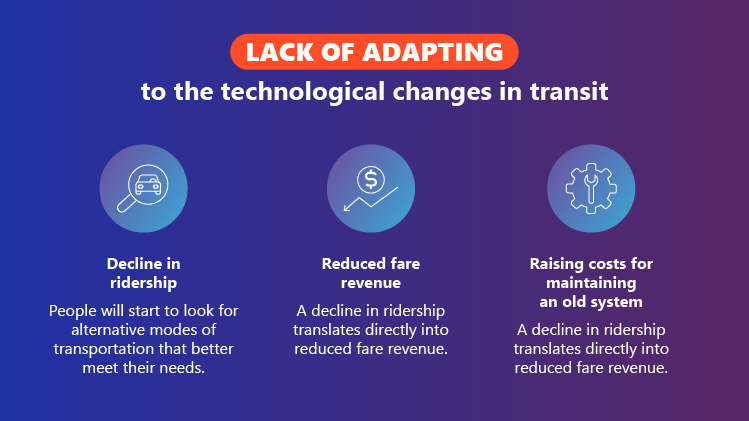
What is more, maintaining old systems usually becomes more expensive for the PTO over time and if the repairs are too frequent it can lead to operational inefficiencies. That is why more agile and smart solutions are indispensable. Evidently, political pressure on public transportation operators and local governments to improve services will always be there. When the technological and customer trends change, failure to keep up with the changes can result in reduced funding and support from policymakers.
There are also issues connected with social inequality. Public transportation is crucial for providing mobility to all segments of the population, and I am not talking solely about low-income individuals and those without access to private vehicles. Nowadays, if we ignore consumer trends and preferences, we effectively exclude people from using public transportation. If I don’t use cash and the PTO uses a cash-only farebox, for instance, I have no other option than to travel by other means of transport. If I don’t want to use my personal data, and I need an account in an app to buy a ticket I’ll most probably give up the idea of taking a bus. People have their preferences and ways of doing things. We need to accept that and offer various options. Being agile in adapting to their needs is the only way to do it. Without adaptation, public transportation systems risk becoming obsolete. This long-term viability issue can lead to a vicious cycle of declining usage, reduced investment, and further degradation of services.